How to Choose Flooring for a Coastal South Jersey Home
The Short Answer: Match the Material to the Moisture and Traffic
The best flooring for a coastal South Jersey home depends on how much water, sand, and humidity the floor actually sees. A shore house entryway, a ground-level utility area, and a second-floor primary bedroom have completely different exposures. To avoid cupping, peeling, or mold, choose the floor based on the subfloor condition, the likelihood of wet foot traffic, and the HVAC control of the home, not just the color.
Many materials marketed as "waterproof" only protect the top wear layer, leaving the subfloor and joints vulnerable to standing water. Our flooring services can coordinate testing the subfloor, planning the transitions, and installing the right system for a coastal environment.
Luxury Vinyl Plank (LVP): The Coastal Standard
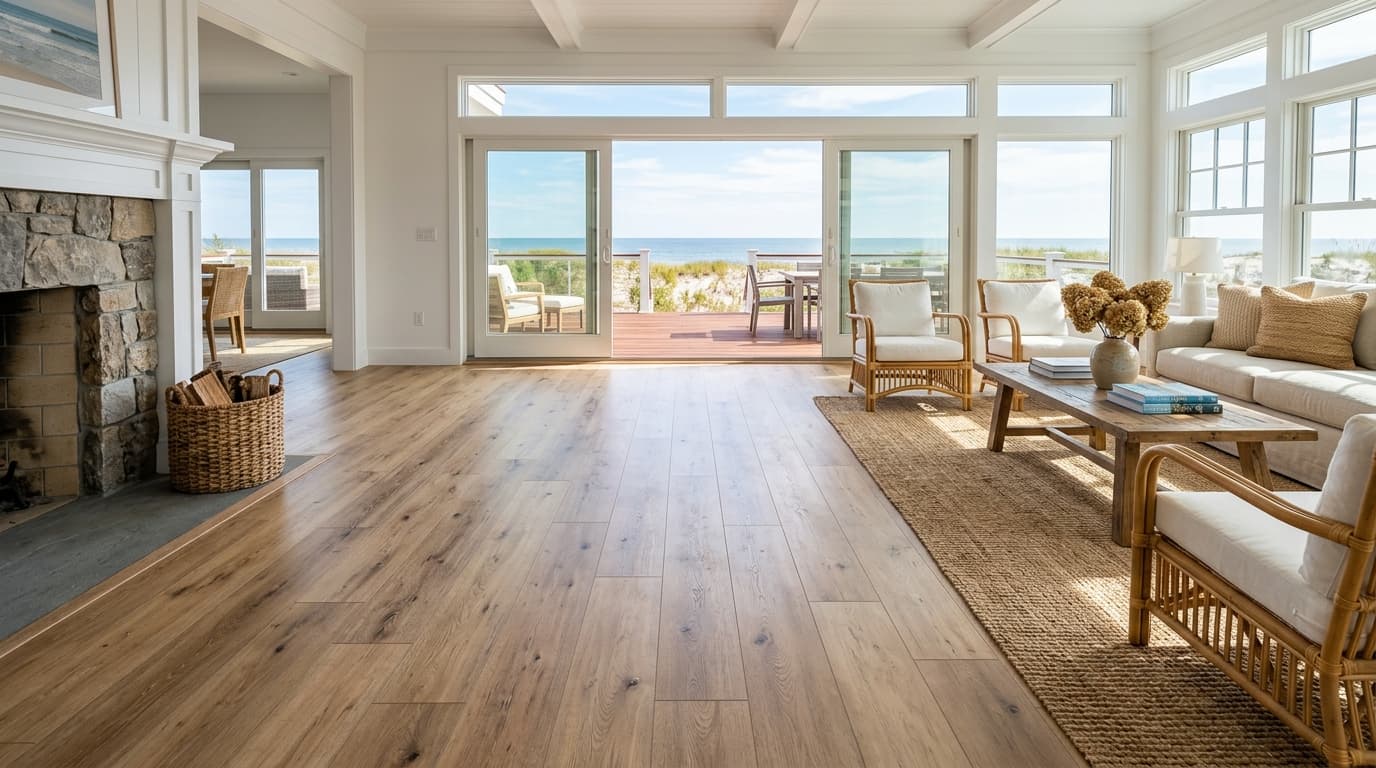
Luxury Vinyl Plank (LVP) is often the standard for shore homes because it resists water, handles sand well, and mimics the look of wood. However, not all LVP is equal. A coastal home needs a product with a thick wear layer (often 20 mil or higher) to withstand the abrasion of sand tracked in from the beach.
LVP is unaffected by typical indoor humidity swings, but a floating LVP floor still requires a flat, dry subfloor. If water gets under a floating plank floor from a sliding door leak or a wet swimsuit puddle left overnight, it can become trapped, potentially leading to mold or odor. For high-moisture areas or three-season homes with large temperature swings, glue-down LVP using the correct adhesive may be a more stable choice than a floating system.
Porcelain Tile: Maximum Durability for Wet Zones
For mudrooms, ground-floor entries, and bathrooms, porcelain tile remains the most resilient option against salt, sand, and standing water. Porcelain is denser and less porous than ceramic tile, making it highly water-resistant. It will not warp, cup, or scratch from beach sand.
The challenge with tile in South Jersey coastal homes is the subfloor assembly. Elevated homes on pilings can have structural deflection (movement or bouncing in the floor joists). If tile is installed directly over a moving subfloor, the grout or the tile itself will crack. A proper installation requires checking the joist spacing, adding an appropriate uncoupling membrane, and ensuring the subfloor meets the stiffness requirements for the specific tile.
Engineered Hardwood: Real Wood with Coastal Risks
Solid hardwood is rarely recommended for coastal homes because it expands and contracts significantly with humidity changes, leading to cupping and gaps. Engineered hardwood—which uses a real wood veneer over a stable plywood core—can be used if the homeowner maintains strict indoor climate control year-round.
If the home is shut down for the winter with the heat turned low, or if the windows are left open to the humid salt air for weeks at a time, even engineered wood can fail. Furthermore, sand acts like sandpaper on wood finishes. If you choose engineered wood for a shore house, keep it in upper-level living areas, use large entry mats to catch sand, and ensure the HVAC system is designed to manage humidity even when the home is unoccupied.
Check the Subfloor and Moisture Before Ordering
No coastal flooring will survive a failing subfloor. Before the new material is installed, the subfloor must be tested for moisture and flatness. For a concrete slab (common in ground-level areas of shore homes), a relative humidity (RH) test should be performed. High slab moisture requires a vapor barrier or a specific moisture-mitigating adhesive.
For wood subfloors, check for soft spots caused by old leaks from sliding doors, windows, or roof damage. The EPA notes that controlling moisture is the key to mold control. Never install a new waterproof floor over a wet or rotting wood subfloor; the new floor will trap the moisture, accelerating structural decay. Our storm-damage services can help coordinate repairs to the building envelope before the finished floor is laid.
Planning a project in South Jersey?
Get a free, detailed estimate from a licensed NJ contractor — no pressure, no sales pitch.
Coordinate Transitions and Exterior Doors
In a coastal home, the floor meets the outside world at decks, balconies, and entry doors. The height of the new floor must be coordinated with the exterior thresholds. Adding a thick tile assembly or a new layer of underlayment might interfere with an inward-swinging door or create a trip hazard at a sliding door.
Inspect the weatherstripping, sill pan, and exterior flashing at every door before laying the floor. A leaking slider will ruin the adjacent floor, regardless of the material. Our general contracting team can address door replacements, weather-sealing, and structural subfloor repairs so the new flooring is protected from the coastal weather.
What a Coastal Flooring Quote Should Include
Compare the preparation and the installation method, not just the price per square foot:
- Subfloor prep: Flattening the floor, sanding seams, or pouring self-leveling compound.
- Moisture testing: Checking the slab or wood subfloor before installation.
- Material specifics: The exact product name, wear layer thickness (for LVP), or membrane type (for tile).
- Transitions: How the floor will meet stairs, sliding doors, different rooms, and baseboards.
- Furniture and appliances: Moving items and carefully disconnecting/reconnecting appliances.
- Acclimation: How long the material will sit in the conditioned home before installation.
- Unknowns: A clear process for handling damaged subfloor or old leaks discovered during demolition.
A South Jersey Coastal Flooring Checklist
Before ordering flooring for your shore home, answer these questions:
- Is the HVAC system run year-round to control humidity, or does the house experience large temperature swings?
- Will wet bathing suits, sand, and pets be a daily factor in this specific room?
- Has the subfloor been checked for moisture, flatness, and structural deflection?
- Are the exterior doors and sliding glass doors fully weather-tight?
- Will the new floor height clear all doors and appliances?
Do not lay "waterproof" flooring over a known leak as a quick fix. If you discover a soft subfloor, water stains near a door, or signs of mold, stop the flooring project and fix the envelope first. Use our contact page to discuss a complete flooring plan for your coastal property.