How to Plan Radon Testing and Mitigation in a South Jersey Home
The Short Answer: Test Before You Finish or Enclose the Basement
The best time to plan radon testing in a South Jersey home is before a basement or crawl space is finished, remodeled, or made more airtight. Radon is a naturally occurring radioactive gas that can move from soil into buildings through cracks, joints, utility penetrations, sump openings, and other pathways. You cannot identify it by smell or appearance, and a clean-looking basement is not proof that the indoor level is low.
Start with a properly placed test, then use the result and the building conditions to decide whether mitigation is appropriate. A radon test is not a substitute for a moisture inspection, and a sump pump or dehumidifier does not remove radon by itself. Our basement finishing services can coordinate access and finish sequencing, while a qualified radon professional should design and install the mitigation system.
Why South Jersey Homeowners Should Treat Radon as a Building-System Question
Radon comes from uranium naturally present in soil and rock, so the risk is not limited to old houses, visibly damp foundations, or one type of neighborhood. The New Jersey Department of Environmental Protection's Radon Program explains that testing is the only way to know the level in a particular home. Coastal, inland, slab-on-grade, crawl-space, and basement properties can all require different testing and mitigation conversations.
The EPA's radon resourcesdescribe radon as a health risk and recommend action when test results are elevated. That guidance is not a prediction about one address. It is a reason to measure rather than rely on a neighbor's result, a real-estate listing, or a guess based on whether the home has a sump pit.
Treat the project as a system: soil contact, foundation openings, pressure differences, HVAC operation, sump and drainage details, occupied rooms, and future finishes all affect the plan. A mitigation pipe installed without understanding the foundation may leave pathways untreated or become inaccessible behind new walls.
Choose a Test That Answers the Question You Actually Have
Short-term tests can provide a timely screening result, while longer tests can show a broader picture of changing conditions. Follow the test device instructions exactly, place it in the lowest lived-in level or the location specified by the testing program, and keep doors and windows operating as instructed. Do not place a device in a bathroom, closet, crawl space, sump pit, or directly beside a draft, exterior opening, heat source, or ventilation equipment unless the instructions specifically call for that location.
A test performed during a renovation may not represent the home after windows, doors, exhaust fans, insulation, or basement finishes change the air paths. Keep a record of the dates, weather, HVAC operation, basement condition, test location, device, and laboratory or provider. If the result is unexpectedly high, inconsistent, or affected by unusual building conditions, repeat testing or obtain professional guidance rather than hiding the device or immediately sealing every crack.
If you are buying or selling, ask who placed the device, whether the protocol was followed, whether the report identifies the exact location and dates, and whether mitigation equipment was operating. A single number without test context is not a complete decision record.
Interpret Results Without Treating One Reading as a Guarantee
The EPA uses 4 picocuries per liter (pCi/L) as an action level and recommends considering steps to reduce radon between 2 and 4 pCi/L. The New Jersey program and EPA materials should be read together with the actual report and current professional advice; a result is not a promise that a future test will match it. Radon levels can vary by season, weather, pressure, ventilation, and how the home is used.
Do not describe a result as “safe” simply because it is below an action level. Instead, record the value, test duration, location, and conditions, then decide whether to repeat the test, consult a qualified provider, or proceed with mitigation. If anyone in the household has health concerns, discuss the exposure with a medical professional; a contractor cannot provide individualized medical advice.
A high result in a basement does not tell you that every upstairs room has the same concentration, but it does deserve a building-wide response. Ask how the proposed mitigation will be verified after installation rather than accepting a claim that a fan or pipe automatically solves the problem.
Compare Mitigation Systems by the Soil-Gas Path and the Finish Plan
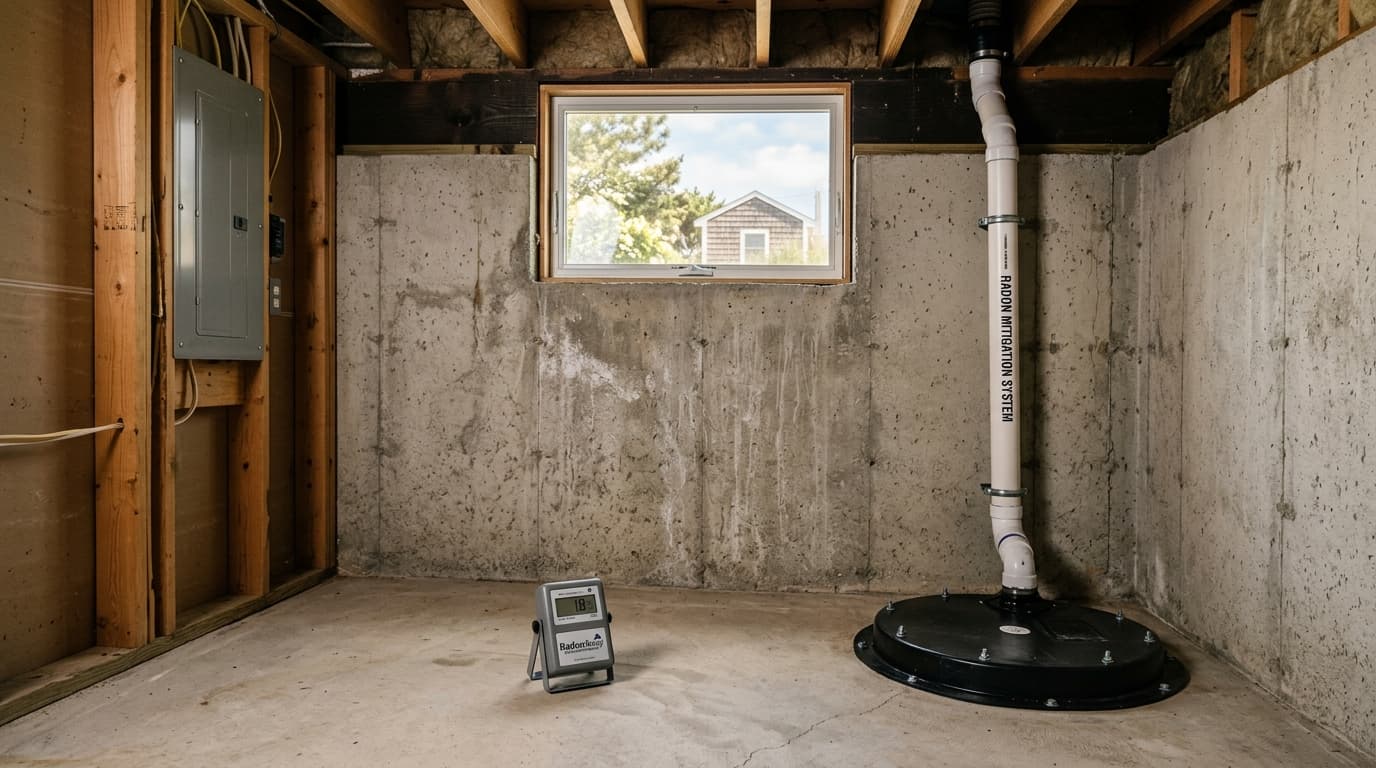
Most active mitigation approaches collect soil gas below or beside the building and exhaust it outdoors through a fan and vent route. The appropriate approach depends on the foundation, slab, crawl space, sump, drains, utility penetrations, and the spaces that are occupied. The EPA's Consumer's Guide to Radon Reduction describes common methods and why a qualified professional should evaluate the home before selecting one.
A complete proposal should show the suction point or points, slab or soil connection, sump cover, pipe route, fan location, exterior discharge, electrical supply, condensate or water considerations, alarms or warning labels, penetrations, and post-installation testing. It should also show what remains accessible after drywall, cabinets, flooring, or insulation are installed. Do not bury a fan, disconnect, cleanout, or test point behind a finished wall without a documented service plan.
The pipe route may pass through a basement, garage, attic, or exterior wall depending on the design. Coordinate roof, siding, framing, electrical, and finish work so the penetration is weather-tight and the system remains inspectable. Our general contracting services can coordinate the building scopes, but the radon design, electrical connection, and any regulated work should have clearly named qualified professionals.
Planning a project in South Jersey?
Get a free, detailed estimate from a licensed NJ contractor — no pressure, no sales pitch.
A Radon Mitigation Quote Checklist
Compare the whole system, not just the fan price:
- Testing: What test records, results, and building conditions were used to design the system?
- Foundation: Which slabs, crawl spaces, sumps, drains, cracks, and soil-contact areas are included?
- Collection: Where are suction points, sealed covers, membranes, or other collection details shown?
- Discharge: Where does the pipe exit, and how are exterior weather sealing, snow, rain, and occupied openings addressed?
- Fan and power: What model, location, electrical connection, noise, service access, and warning indicators are specified?
- Finishes: How will framing, drywall, flooring, insulation, trim, and roof or siding penetrations be restored?
- Verification: When will the post-installation test occur, who interprets it, and what happens if the result remains elevated?
- Approvals: Who confirms permits, inspections, trade responsibilities, and local requirements?
New Jersey requirements depend on the actual building, electrical, structural, mechanical, and finish scope. NJ DCA's Codes & Standards resources are a starting point, but the local construction official determines what applies to the address. Ask for permit and inspection responsibility in writing.
Keep Radon Work Compatible with Moisture Control and Future Remodeling
Radon mitigation and basement moisture work can meet at the sump, slab, foundation wall, and utility penetrations, but they solve different problems. A sealed sump cover may be part of a radon system and still need to preserve pump access, discharge inspection, and safe electrical service. A vapor barrier or crack seal may reduce one pathway without correcting water pressure or a leaking pipe.
Plan the system before installing walls or flooring. Photograph pipes and access points, leave service clearances, protect the fan from impact and standing water, and make sure the exhaust cannot terminate near a door, window, intake, or other location where soil gas could re-enter. If a finished basement is already damp, the storm-damage and water-response scope should distinguish drying and repair from radon work.
For a home in Egg Harbor Township, Galloway, Absecon, or another South Jersey community, bring test reports, foundation photos, sump details, renovation plans, and any history of water entry to the review. Our contact page is a starting point for a documented building-scope conversation, not a substitute for radon testing or medical advice.
Know When to Stop and Call a Qualified Professional
Do not drill a slab, cut a foundation, open a crawl space, alter electrical wiring, move combustion equipment, or disturb suspected mold or asbestos as a DIY shortcut. Stop when you find standing water, damaged wiring, structural cracking, contaminated material, an inaccessible crawl space, or a proposed pipe route that would compromise a roof, wall, or fire separation.
After installation, follow the system maintenance instructions and arrange the recommended follow-up test. Watch for a fan alarm, unusual noise, disconnected pipe, damaged exterior termination, water around a suction point, or a result that remains elevated. Keep the mitigation system visible and serviceable, and retain the original and follow-up reports with your home records.
The useful goal is not merely to own a radon fan. It is to have a tested, appropriately designed, verifiable, maintainable system that remains compatible with the rest of the home. That process gives a South Jersey homeowner evidence for the next decision instead of a guess based on a single device or a sealed crack.